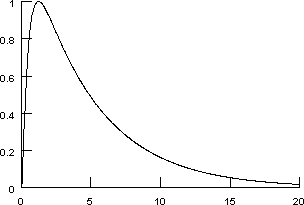
Horizontal axis is in milliseconds.
But if you absolutely must know how we cooked up these data . . .
A presynaptic spike causes release of agonist A which binds rapidly (but not instantaneously) to the closed form of the channel Rc. The ARc complex can either dissociate, which destroys the agonist and leaves the channel closed, or it can undergo a conformational change to ARo, in which the channel is open.
Binding of A to R
         k1
  A + Rc --> ARc
where each synaptic activation adds the same amount of A to the
system, and k1 is much faster than the other rate constants.
Dissociation of ARc
      k2
  ARc --> Rc
Channel gating
       alp
  ARc <---> ARo
       bet

  g = gmax*ARo*scalefactor
where scalefactor has a value such that a sudden increase of A from 0 to 1
produces a peak conductance of gmax.
Conservation
R + ARc + ARo = 1This means the conductance saturates.
With k1 = 100/ms, k2 = 1/ms, alp = 1/ms, bet = 0.5/ms, and scalefactor ~ 2.92651, a single synaptic activation with a weight of 1 (i.e. activation makes A jump from 0 to 1) produces the conductance transient shown here.
The complete model that produced this transient is contained in synap.zip, which is packaged with this tutorial.
[
Copyright © 2003 by N.T. Carnevale and M.L. Hines, All Rights Reserved.